Key Takeaways
- Telehealth can support ADHD treatment, but stimulant prescribing requires stricter safety standards.
- Dr. Ryan Sultan emphasizes that in-person evaluations detect crucial mental-status findings telehealth may miss.
- “Telemoney” platforms created public-safety risks by overprescribing without adequate assessment.
- Hybrid care models offer the best balance of access and safety.
- ADHD overlaps with anxiety, depression, OCD, BPD, autism, eating disorders, and psychosis—requiring nuanced diagnosis.
- High-quality clinics like Integrative Psych provide ethical, evidence-based ADHD evaluations in NYC and Miami.
Why Telehealth Prescribing for ADHD Has Become a National Debate
Telehealth exploded during the COVID-19 pandemic. For many patients—especially those with ADHD—it offered unprecedented access to psychiatric care. Virtual appointments reduced wait times, eased scheduling burdens, and expanded care to rural or mobility-limited individuals.
But telehealth prescribing for ADHD became controversial when certain high-volume platforms (often backed by private equity or insurer-owned conglomerates) began diagnosing ADHD in 5–10 minute appointments, prescribing controlled stimulants with minimal evaluation, and marketing aggressively on social media.
Dr. Ryan Sultan, a leading psychiatrist and ADHD researcher, emphasizes:
“Telehealth rules for stimulants existed for a reason. Stimulants are high-risk medications. In-person evaluation is a small ask for something as substantial as a controlled substance.”
Many clinicians agree: telehealth has a place, but stimulant prescribing must be done responsibly, with comprehensive evaluation and safeguards in place.
What Makes ADHD Stimulant Prescribing Different?
Stimulant medications such as Adderall, Vyvanse, Ritalin, and Concerta are classified as Schedule II controlled substances due to risks including:
- misuse
- diversion
- dependence
- cardiovascular effects
- psychiatric destabilization
These risks are even higher for individuals with co-occurring mental-health conditions such as anxiety, depression, OCD, bipolar disorder, psychosis, schizophrenia, or eating disorders, all of which require careful psychiatric assessment.
Therefore, high-quality ADHD evaluation routinely includes:
- a full psychiatric interview
- developmental history
- collateral information when possible
- a detailed mental status exam
- screening for conditions like OCD, BPD, psychosis, or trauma
- differential diagnosis
- consideration of non-stimulant treatment paths
This depth is difficult—often impossible—to replicate with rushed or low-quality telehealth models.
Why Regulations Are Tightening Again
During the pandemic, the federal government temporarily loosened telehealth rules to maintain access to care. This allowed clinicians to prescribe stimulants without in-person visits.
But data soon revealed problems:
- “Telemoney” platforms issued prescriptions with minimal assessment
- Private equity companies cut corners to maximize profit
- Misdiagnosis rates rose
- Diversion increased
- Certain clinics were investigated for unsafe practices
As Dr. Sultan warns:
“Telehealth rules must be rolled back to protect the public and maintain a minimal level of public safety and quality healthcare.”
Today, many experts advocate for a hybrid model:
- telehealth when appropriate
- in-person visits for stimulant initiation or complex evaluations
What Does a High-Quality ADHD Evaluation Look Like?
A thorough ADHD evaluation—whether in person or hybrid—must include a psychiatric mental status exam. This is especially important because ADHD can mimic or overlap with:
- Anxiety disorders (hyperarousal mistaken for distractibility)
- Depression (low motivation misread as inattention)
- Obsessive-Compulsive Disorder (slowed productivity due to compulsions)
- Autism spectrum traits
- Borderline Personality Disorder (emotional dysregulation)
- Schizophrenia or psychosis (thought disorder or disorganization)
- Eating disorders (stimulants suppress appetite and may worsen symptoms)
Proper evaluation is critical—and this is where high-quality care settings like Integrative Psych, and their teams in both NYC and Miami, differ from high-volume telehealth startups.
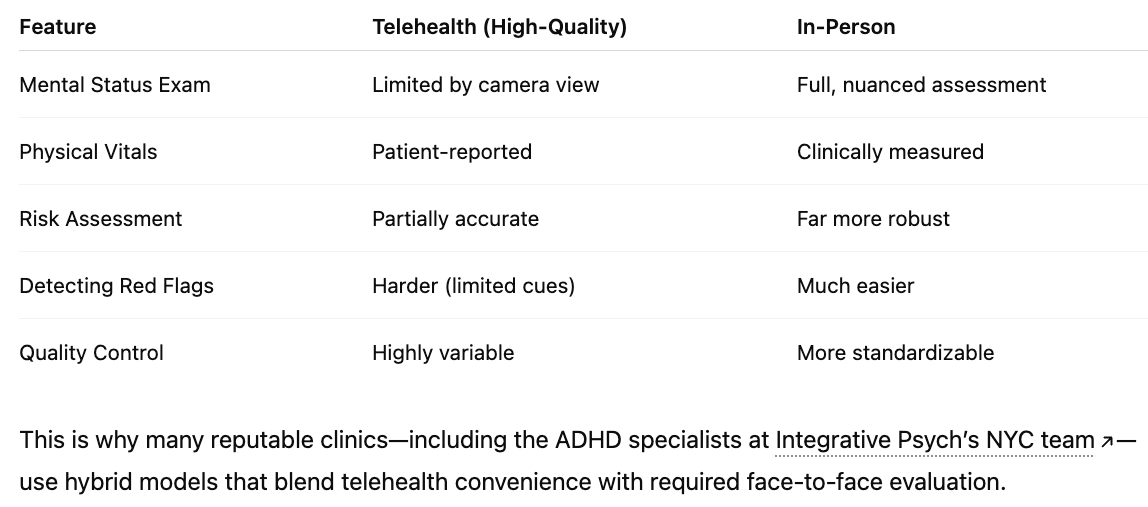
Telehealth ADHD Prescribing vs. In-Person Care: Key Differences

This is why many reputable clinics—including the ADHD specialists at Integrative Psych’s NYC team—use hybrid models that blend telehealth convenience with required face-to-face evaluation.
Why In-Person Assessment Matters for ADHD
Dr. Sultan emphasizes:
“The evaluation of ADHD is far superior in person—where a mental status exam can be properly completed.”
In-person exams better detect:
- subtle motor hyperactivity
- impulsivity
- fidgeting
- eye contact issues
- mood instability
- signs of psychosis or mania
- neurological soft signs
- compulsions (OCD)
- trauma manifestations
These elements can dramatically change diagnosis and treatment, especially when considering:
These risks underscore the necessity for appropriate guardrails.
The Role of High-Quality Telehealth (Not Telemoney Models)
Responsible telehealth is still extremely valuable. Clinics such as Integrative Psych’s Miami psychiatrists embrace ethical virtual care while maintaining safety standards.
Ethical telehealth includes:
- adequate appointment duration
- comprehensive assessment
- clear documentation
- safe stimulant prescribing
- follow-up monitoring
- integration with psychotherapy such as CBT, DBT, EMDR, or trauma-informed care
This stands in stark contrast to profit-driven “fast ADHD evaluations” that prioritize volume over patient welfare.
A Note on Intersectional Mental-Health Needs
Telehealth prescribing must also account for populations with unique vulnerabilities, including individuals seeking:
- Adult ADHD treatment
- LGBTQ-affirming care
- Autism evaluations
- Eating-disorder support
- Women’s mental-health care
These clinical needs often interact with ADHD symptoms—and must be evaluated with nuance that telehealth shortcuts often miss.
About Integrative Psych in Chelsea, NYC and Miami
Integrative Psych is a national leader in responsible psychiatric care, offering evidence-based ADHD evaluations, diagnostic clarification, and safe prescribing practices. Their team includes board-certified psychiatrists, psychologists, and therapists specializing in:
- ADHD
- anxiety
- depression
- OCD
- BPD
- trauma
- psychosis
- addiction
- eating disorders
Care is accessible through both in-person and virtual appointments. Learn more through: